
Dead people making music
Most artworks and music get lost or are ignored. So why do we keep doing it?

The title idea came to me first, offering itself for my intuition to explore its inherent possibilities. Beginning to write in this manner gives way to many potential ramifications. So here’s an interesting one I thought of: music by dead people that never saw the light of day.
I’ll start with some rather general related questions, like how many composers must have written music in the past. And how many of them do we actually know. Also, how much of their music has been lost and forgotten. Music by thousands, dispersed throughout history, many of which has never even been performed. Just scribbles of music notation on now disintegrated paper, or more recently, recordings trapped in digital or analog media, hidden or degraded. Music lost and destroyed by indifference.
Sometimes I muse about such things. I look at my scores, music pages that take hours to create and notate, and ponder about the relevance of it all, but also about its apparently absurd tragedy. One page from my scores is usually one minute of music for the listener. For me, that one page is a multi-hour creative experience, being immersed in my imagination and thoughts. The resulting music, done for others to interpret and perform, is an artistic process of the utmost personal relevance. At the same time, it’s music that most people don’t need or find use for, and probably never will.
But do I need it or find it useful for myself? More on that later.
It’s frequently said that creative people and artists keep the world alive and spinning, countering anti creative forces in our societies. Has that been the unbeknown retribution for all of those artists whose hundreds of hours of work have glided into the dark abyss of indifference?
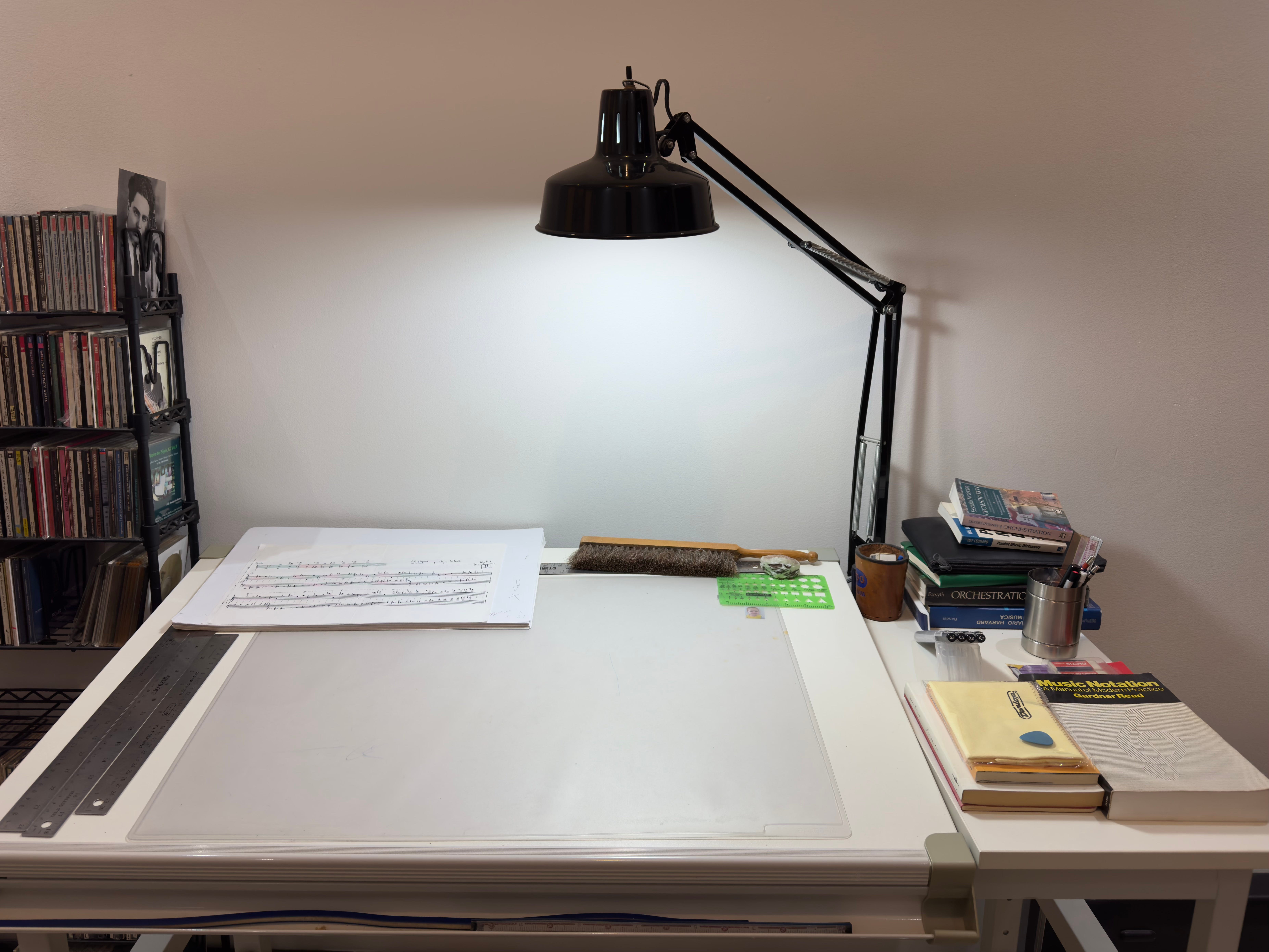
I see dead people, as the immortalized movie phrase goes. I see them writing at their desks with a mind attuned to both worlds, the inner and the outer. I see them glazing for hours at staff music, at a notebook or a canvas, trying to make what seems to be the most important decision of their lives at that precise moment. I see them pouring themselves into the art, into the music, becoming that which they are creating. I see them creating themselves. I see them surrounded by their books, their records, their notes and memories. Surrounded also by a world of indifference.
I see dead people buried by neglect. Some with their coffins shut with the nails of ridicule. Some disposed of in mass graves of anonymity.
Nevertheless, they carried on. And many of us are still at it. We, the ones conscious of the fates of these fine dead men and women. But why? To continue their work, the work of humanity for humanity? Even if it means only our own humanity?
Are we just dead men walking? Dead women carrying in their wombs the aesthetic insights and wonders that can save us, with very few realizing it or caring about it?
I may be painting a bleak landscape, but that’s not my point. Rather, what I want to convey is that we can come to a different understanding of all this. We can focus not only on the sacrificed artist and his or her neglected work, but on the blossoming creative spirit.
I asume that most artists want others to experience their work. It might be in some way or another and varying degrees. But is that really what we all need? It’s important that it happens, for the artist and the recipients of the work. It’s even necessary for the complete experience of art to take place. But then again, do we need it? Why are we tolling away making music and art when there are certainly better ways to grab other’s attention.
I think we need the making of it, the process of art. Is there necessarily a purpose outside of itself? Not really. If you think about it, and without trying to appear nihilistic, nothing has a purpose. As the Angelus Silesius quote goes, “the rose is without an explanation; it blooms, because it blooms.” Everything is gratuitous, and it’s within that gratuity that the true and grandest value of art resides. In its making.
Perhaps the message is incomplete without a recipient, but the work is there by and for the artist first. In our hearts and minds coalescing in the revelatory creation of beauty. Beauty in its widest and wildest sense. The spirit is simultaneously nourished and exalted by the emergence of something that was not here before.
And yes, we like to share it, it’s natural. I know some will disagree, but I believe art to be a specific type of communication. A metaphoric one perhaps, but meaningful nonetheless. So now another question needs attention: communication between who or what. Is it between the artist and an audience? Or is it between the artist and the world, through his/her awareness? Both perspectives exist, of course, even simultaneously, but with one having predominance over the other. Which one are we favoring. For myself, I’ll go with the openness that awareness brings. Like the poet Hugo Mujica says, an awareness where one doesn’t project the self towards the world, opening instead to the world and letting it transform us.
I see dead people. Some searching for recipients of their work, to be heard or seen. Some achieved it, many didn’t. I also see those who found through their art a world within themselves, who connected with life in a very meaningful and personal way. We are fortunate to know some of them, some of their art, but many others we don’t.
Nevertheless, I am grateful to them.
.
I like it!